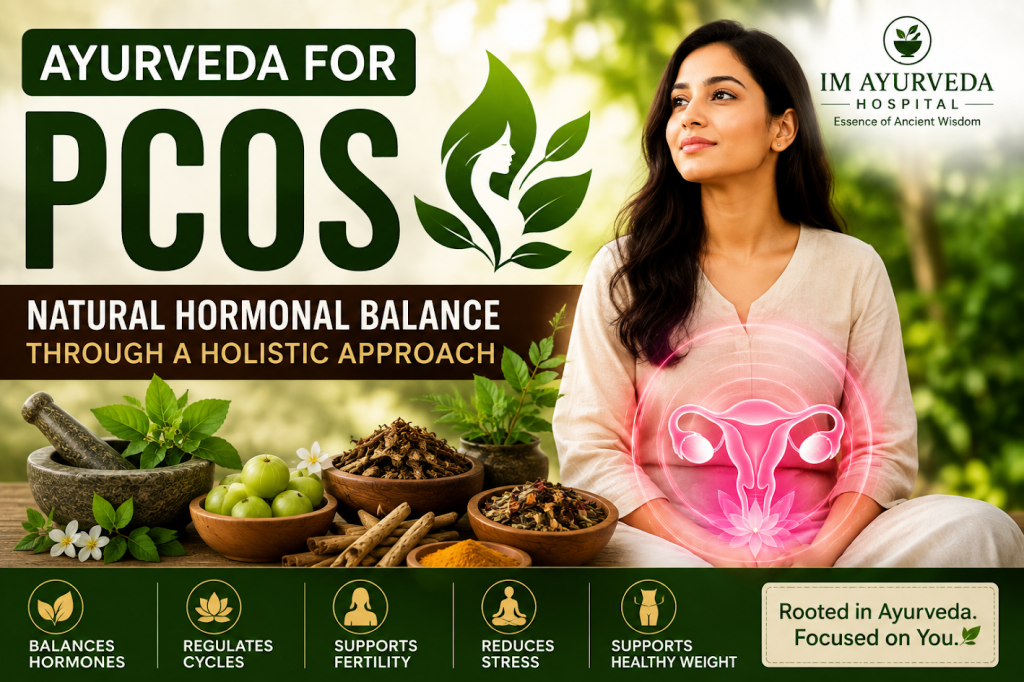
Polycystic ovary syndrome (PCOS) is a complex hormonal and metabolic disorder that impacts menstrual cycles, ovulation, skin, hair growth, body weight, insulin regulation, and fertility. Since symptoms vary widely among women, no single remedy addresses all aspects of the condition.
Ayurveda for PCOS offers a holistic approach. Instead of targeting a single hormone or symptom, Ayurveda considers digestion, metabolism, reproductive health, daily routine, stress, sleep, Dosha balance, and the individual’s constitution.
Modern research is increasingly examining Ayurvedic and other traditional approaches to PCOS. A 2025 systematic review in Indian women with PCOS included herbal medicines, yoga, dietary interventions, and other non-pharmacological methods, highlighting this as an active area of clinical study.
At I’M Ayurveda, this comprehensive perspective forms the foundation of an individualised approach to PCOS and hormonal wellness.
Important: PCOS has diverse causes and presentations. Ayurvedic treatment should be personalised, and prescribed medicines or fertility treatments should not be discontinued without professional guidance.
What Is PCOS?
PCOS is a common endocrine and metabolic disorder associated with reproductive and hormonal changes. Common manifestations include irregular menstrual cycles, difficulty with ovulation, acne, increased facial or body hair, scalp hair thinning and difficulties with fertility.
PCOS can also be associated with metabolic concerns such as insulin resistance, dyslipidemia and increased long-term cardiometabolic risk.
Importantly, not every woman with PCOS has the same symptoms. Some may primarily experience irregular periods, while others may struggle with acne, unwanted hair growth, weight changes or fertility.
This underscores the importance of individualised care.
How Does Ayurveda Understand PCOS?
Ayurveda does not have a one-to-one equivalent of the modern diagnostic term “PCOS.”
Instead, Ayurvedic physicians may assess the condition through concepts such as:
- Dosha imbalance
- Agni and digestion
- Meda Dhatu and metabolic function
- Artava and menstrual health
- Apana Vata
- Accumulation or impaired movement of physiological processes
- Lifestyle and dietary patterns
Ayurvedic assessment therefore considers factors beyond the ovaries.
The goal is to identify the underlying causes of menstrual, metabolic, and reproductive disturbances and to develop a personalised treatment strategy.
1. Restore Healthy Metabolic Balance
Metabolism is an important part of PCOS management.
Ayurveda emphasises Agni, which represents digestive and metabolic function. Poor dietary habits, irregular meals, sedentary behavior, and metabolic function.
Practical measures can include:
- Eating meals at consistent times
- Choosing nutrient-dense foods
- Reducing excessive refined and ultra-processed foods
- Maintaining appropriate physical activity
- Avoiding habitual overeating
- Supporting healthy sleep
Modern PCOS guidelines also emphasise lifestyle management, including healthy eating and physical activity, to improve metabolic health and overall quality of life.
Interestingly, lifestyle improvement can be beneficial even without significant weight loss, which is important because PCOS is not simply a weight-related disorder.
2. Ayurvedic Herbs and Formulations
One of the most interesting aspects of Ayurveda is its extensive Dravyaguna tradition.
Ayurveda does not rely on only two or three “PCOS herbs.” Different medicinal plants, fruits, roots, seeds, spices and classical formulations may be selected according to the individual’s presentation.
Depending on the Ayurvedic assessment, practitioners may consider herbs traditionally associated with:
- Metabolic balance
- Menstrual regularity
- Reproductive health
- Digestion
- Stress management
- Rasayana
- Healthy circulation
- General vitality
The key is to select herbs and formulations based on individual needs, rather than using supplements indiscriminately.
Research is beginning to examine these approaches. A 2026 randomised, double-masked, placebo-controlled trial of standardised Shatavari root extract in women with PCOS found significant reductions in perceived stress, follicular count and an increase in endometrial thickness. However, it did not find significant differences in BMI or several hormonal/laboratory outcomes.
This illustrates both the potential and the importance of evaluating individual Ayurvedic interventions scientifically.
3. Support Menstrual Regularity
Irregular periods are one of the most recognisable manifestations of PCOS.
From an Ayurvedic perspective, menstrual health is connected with Artava, Apana Vata, digestion, metabolism and overall reproductive health.
An individualised Ayurvedic program may therefore focus on:
- Improving dietary habits
- Supporting digestion
- Correcting lifestyle irregularities
- Managing stress
- Improving physical activity
- Using appropriately selected traditional medicines
- Supporting healthy sleep
The objective is not simply to induce a period artificially, but to work toward better menstrual and reproductive balance.
4. Ayurveda and Insulin-Related Metabolic Health
Insulin resistance is an important component of PCOS for many women, although it does not occur identically in everyone.
This makes metabolic health an important consideration in Ayurvedic PCOS care.
Diet, exercise, sleep and weight management—where appropriate—can all contribute to better metabolic health. Current international PCOS guidance recommends lifestyle intervention for improving metabolic health, including central adiposity and lipid profile.
Ayurveda can complement this through individualised dietary recommendations, digestive support, activity, daily routine and selected traditional medicines.
5. Yoga for PCOS and Hormonal Wellness
Yoga is particularly compatible with the holistic philosophy of Ayurveda.
Regular yoga may combine:
- Physical movement
- Breathing practices
- Relaxation
- Mindfulness
- Stress regulation
Research has produced encouraging findings. A randomised controlled study found that regular mindful yoga was associated with lower free testosterone levels and improvements in anxiety and depression in women with PCOS.
A newer 2026 systematic review also found that yoga may have beneficial effects across several PCOS-related outcomes, although the researchers noted variation among the available studies.
For an Ayurvedic program, yoga can therefore be incorporated as part of whole-person hormonal wellness, rather than treated as an isolated exercise.
6. Stress Management Is Part of Hormonal Care
PCOS is not only about reproductive hormones.
Women with PCOS may also experience psychological stress, anxiety, body-image concerns and emotional fatigue.
Ayurveda traditionally gives considerable importance to mental balance and daily routine.
Practices such as:
- Meditation
- Pranayama
- Gentle yoga
- Abhyanga where appropriate
- Consistent sleep
- Regular meals
- Time outdoors
- Reduced overstimulation
may form part of a broader Ayurvedic wellness plan.
The goal is to create a routine that the body and mind can sustain rather than following an unnecessarily restrictive “hormone detox.”
7. Ayurvedic Approach to PCOS-Related Weight Changes
Weight changes can be part of PCOS, but PCOS is not simply a weight-loss problem.
Some women with PCOS are not overweight at all, while others experience difficulty managing weight despite making lifestyle changes.
Ayurveda can individualise dietary and lifestyle recommendations according to constitution, digestive capacity, activity level and metabolic pattern.
The modern international guideline similarly recommends focusing on a healthy lifestyle and prevention of excess weight gain even in women who are not overweight.
Therefore, an Ayurvedic PCOS program should avoid imposing aggressive calorie restriction on all women.
8. Supporting Skin and Hair Health
Hormonal changes associated with PCOS can contribute to:
- Acne
- Oily skin
- Increased facial hair
- Scalp hair thinning
Ayurveda addresses these concerns within the broader context of overall health, rather than treating skin or hair issues in isolation.
Dietary habits, stress, digestion, sleep, hormonal balance and individualised herbal care can all be considered.
The objective is to address underlying causes while providing suitable internal and external support.
9. Ayurveda and Fertility in PCOS
PCOS is one of the common causes of ovulatory dysfunction and can make conception more difficult for some women.
Ayurveda traditionally places considerable emphasis on reproductive health, nourishment and preparation for conception.
An Ayurvedic fertility-focused approach may consider:
- Menstrual regularity
- Ovulation
- Nutrition
- Digestive health
- Stress
- Sleep
- Physical activity
- Reproductive vitality
- Individual herbal and therapeutic support
This should not be interpreted as a guarantee of pregnancy.
However, research into traditional and herbal approaches for PCOS-related reproductive outcomes is expanding. A 2025 systematic review of interventions in Indian women with PCOS identified evidence across pharmacological and non-pharmacological approaches, including herbal interventions and yoga.
10. Ayurveda Looks Beyond a Single Hormone
One important difference in the Ayurvedic perspective is that hormonal health is not necessarily viewed in isolation.
A woman may have PCOS together with:
- Digestive problems
- Poor sleep
- Stress
- Weight changes
- Acne
- Hair changes
- Irregular menstruation
- Reduced energy
- Fertility concerns
Instead of prescribing the same “PCOS medicine” to every woman, Ayurvedic treatment seeks to understand how these factors interact.
Personalised Ayurveda for PCOS offers a more meaningful approach than generic online remedies.
Can Ayurveda Cure PCOS Naturally?
PCOS is a complex condition, and the word “cure” can be misleading because PCOS can have long-term and fluctuating manifestations.
However, PCOS symptoms and metabolic or reproductive abnormalities can often be managed and improved.
Ayurvedic care may focus on improving menstrual regularity, metabolic health, stress, lifestyle, digestion, reproductive wellness and other individual symptoms.
Clinical research is encouraging but still developing. For example, an Indian systematic review identified multiple clinical trials involving lifestyle, yoga and herbal interventions for PCOS. In contrast, a recent Shatavari trial and other studies add to the growing evidence base.
A responsible Ayurvedic approach focuses on restoring physiological balance and improving quality of life, rather than promising permanent resolution of PCOS for every patient.
Treatment Take?
There is no universal treatment duration.
PCOS develops differently in different women, and the response to treatment can depend on:
- Age
- Menstrual pattern
- Metabolic health
- Lifestyle
- Sleep
- Stress
- Duration of symptoms
- Fertility goals
- Individual Ayurvedic constitution
- Adherence to the treatment plan
Some changes may become noticeable relatively early, while menstrual and metabolic improvements may require sustained lifestyle and therapeutic intervention.
Ayurveda generally emphasises consistent long-term habits rather than short detox programs.
Can Ayurveda Be Used Alongside PCOS Medication?
Ayurvedic care can potentially be integrated with conventional PCOS management, but the relevant healthcare professionals should review medicines and supplements.
This is particularly important when someone is using:
- Hormonal medicines
- Fertility medicines
- Metformin
- Blood-pressure medication
- Antidepressants
- Supplements
- Other long-term medicines
The goal should be coordinated care, not discontinuing existing treatments independently.
Why Choose I’M Ayurveda for PCOS Care?
At I’M Ayurveda, PCOS is addressed as a whole-body hormonal and metabolic concern, not solely as an ovarian issue.
An Ayurvedic consultation may consider menstrual history, digestion, lifestyle, sleep, stress, body composition, reproductive goals and individual constitution before developing a treatment strategy.
Depending on the assessment, the approach may include traditional Ayurvedic medicines, dietary guidance, lifestyle correction, yoga, Rasayana approaches and other appropriate therapies.
The aim is to support women in achieving better menstrual, metabolic, and reproductive wellness through individualised Ayurvedic care.
Overview
Ayurveda for PCOS is best viewed as a comprehensive approach, not as a single herbal remedy.
PCOS involves reproductive, metabolic, lifestyle and psychological dimensions, and Ayurveda’s traditional framework allows these areas to be considered together.
The emerging research is encouraging: Indian clinical research has examined herbal medicine, yoga, dietary interventions and other approaches, while newer trials are continuing to investigate specific Ayurvedic interventions.
The most effective Ayurvedic approach is not defined by the number of herbs used, but by how well it is tailored to a woman’s constitution, symptoms, metabolic pattern, reproductive goals, and lifestyle.